Brainwaves are electrical impulses in the brain.
Every thought, emotion, and action you experience is the result of communication between billions of neurons. These neurons communicate through synchronized electrical impulses, creating measurable brainwave frequencies. These frequencies vary in speed—some are slow and calming, while others are fast and energizing.
Your brainwaves constantly change based on what you’re doing and how you’re feeling.
- Slower brainwaves are associated with relaxation, drowsiness, and deep sleep.
- Faster brainwaves are linked to focus, alertness, and problem-solving.
Scientists commonly classify brainwaves into five main EEG bands, measured in cycles per second (Hertz, Hz): Delta, Theta, Alpha, Beta, and Gamma.
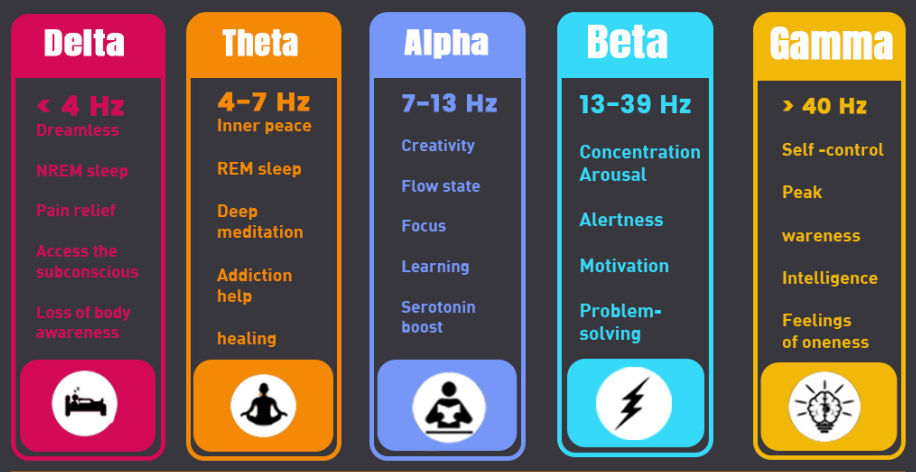
What Brainwaves Mean to You
Each of us, however, always has some degree of each of these brainwave bands present in different parts of our brains. Delta brainwaves will also occur when areas of the brain go “offline” to take up nourishment. If we are becoming drowsy, there are more delta and slow theta brainwaves creeping in. If we are inattentive to external things and our mind is wandering, there is more theta present. If we are exceptionally anxious and tense, an excessively high frequency of beta brainwaves is often present.
Our brainwave profile and our daily experience of the world are inseparable. When our brainwaves are out of balance, there will be corresponding problems in our emotional or neuro-physical health.
Binaural Beats and Music
There are also techniques that use the concept of brain wave entrainment, whereby your brainwaves begin to match or synchronize with the frequency of an external stimulus, like a pulsing sound or a light. You can use this concept to train your brain waves to a particular frequency during a specific task. For example, you may want beta waves while you’re preparing for a test, or alpha or delta waves to help you sleep.
To get our brain on the right wavelength, you can listen to binaural beats, which are basically two different sound frequencies played in each ear.
If you find binaural beats to be a bit boring or repetitive, there are also services that play music designed to enhance certain brainwaves.
Popular Hz Frequencies
In addition to traditional EEG brainwave ranges, certain individual Hz frequencies are widely used in meditation, relaxation, and focus-oriented audio experiences:
- 174 Hz – Often used for deep relaxation and physical release, helping the body unwind and ease tension
- 285 Hz – Commonly associated with body awareness and restorative states, creating a sense of stability and grounding
- 396 Hz – Frequently used for emotional release and stress reduction, supporting the letting go of fear or negative emotions
- 432 Hz – Known for its soft, natural sound quality, often used to promote emotional balance and relaxation
- 528 Hz – Commonly referred to as a “restorative” or “healing” frequency, used to support relaxation and positive mood
- 639 Hz – Often associated with emotional harmony, connection, and balanced relationships
- 741 Hz – Commonly used to support mental clarity, focus, and clearing mental clutter
- 852 Hz – Often linked to intuition, inner awareness, and clearer perception
- 963 Hz – Frequently used for deep meditation and a sense of expanded awareness
These frequencies are not medical treatments, but many users find that listening to them during meditation, relaxation, or focused activities helps create a calmer, more balanced, and more attentive mental state.
Mind Over Matter
Whether you feel stressed or calm, energized or drained, your brainwaves are always shifting. By using sound intentionally, you can gently support your brain in moving toward a more balanced state.
The next time you feel overwhelmed or unfocused, consider what your brain is doing—and how sound can help guide it.